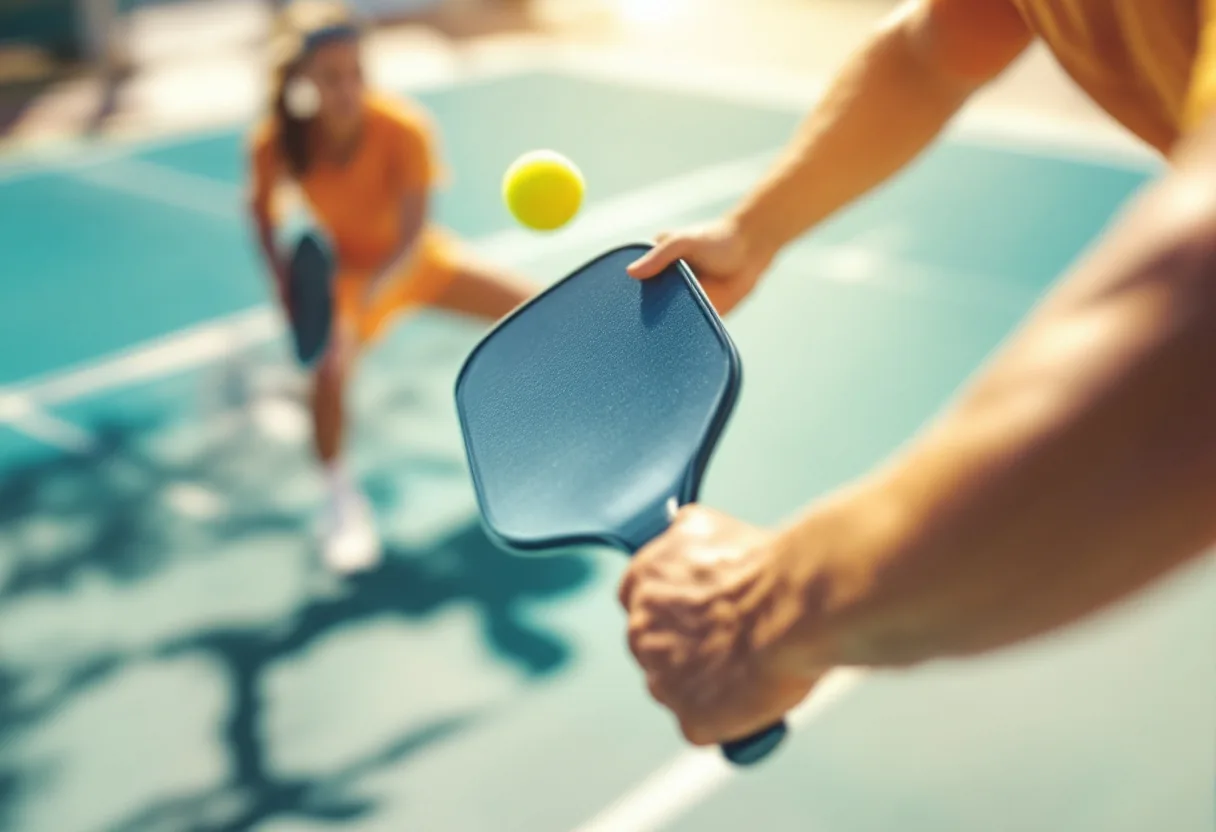
Plenty of homeowners assume their yard is too small or too steep for a pickleball court. In practice, most of those yards can work with smart layout choices. The trick is knowing the real dimensions you need, where you can borrow space, and which features to prioritize when the footprint is tight.
Start with the dimensions that actually matter
The official pickleball play area is 20 feet by 44 feet. That number alone is misleading, though, because you need safety margin around the lines so players are not running into a fence on every shot. The recommended finished pad is about 30 feet by 60 feet, which gives comfortable out-of-bounds room on all sides. If you can fit a 30x60 pad, you have a full, no-compromise court. If you cannot, you still have good options — see full court dimensions and specs for the exact measurements.
| Layout | Pad size | Best for |
|---|---|---|
| Full court, ideal margins | 30 × 60 ft | Competitive play, resale value |
| Full court, reduced margins | 24 × 50 ft | Tight lots, casual play |
| Half-court / practice | 15 × 30 ft | Drills, kitchen practice, kids |
Ideas for a small yard
When square footage is the constraint, a few moves go a long way. Reducing the perimeter margin from the ideal six to ten feet down to four feet recovers a surprising amount of space while keeping the court fully playable for recreational games. Orienting the long axis along the longest run of the yard — often the diagonal — can unlock a footprint that does not appear to fit at first glance. A half-court dedicated to dinking, serving, and third-shot drills is also a legitimate option that fits in roughly 15 by 30 feet and still delivers most of the practice value.
Color choice helps too. A darker out-of-bounds band with a contrasting in-bounds color makes a compact court read as larger and keeps the play area visually clean.
Ideas for a sloped yard
A slope is an engineering question, not a dealbreaker. Builders create a level building pad using cut-and-fill grading, where soil is removed from the high side and used to build up the low side, sometimes paired with a low retaining wall to hold the edge. The finished court is never truly flat: it carries a slight, uniform slope of about one inch per ten feet so water sheets off cleanly. Getting that plane right is the most important part of the job, because standing water and uneven settling are what ruin a surface. If your lot has real grade, factor drainage and a possible retaining wall into the budget early.
On sloped lots, site prep — grading, retaining walls, and drainage — is usually the single biggest line item, not the court surface itself. A site visit is the only way to price it accurately.
Features worth adding when space allows
If you have room beyond the pad, a perimeter fence keeps balls in and defines the space, while court lighting extends play into the evening. Both are far cheaper to install during the original build than to retrofit later, so decide on them before the concrete is poured. A small surrounding apron of turf or pavers also keeps mud off the surface and makes the court feel like a finished part of the yard.
What it costs
A backyard court generally runs $20,000 to $50,000, or about $11 to $28 per square foot installed. Small reduced-margin courts land at the lower end; sloped lots with walls, fencing, and lights climb toward the top. For a number tailored to your yard, the cost guide breaks down every line item.
Not sure your yard will work? Get an instant estimate and a vetted local builder will assess your space and grade before you commit to anything.
FAQ
The official play area is 20 by 44 feet, but a comfortable court needs a padded surface of about 30 by 60 feet for safe out-of-bounds movement. If 30x60 will not fit, a reduced-margin full court (around 24x50) or a 15x30 half-court for drills both work well.
Yes. Sloped yards are handled with cut-and-fill grading and sometimes a small retaining wall to create a level pad. The finished court still carries a slight, uniform slope of about one inch per ten feet for drainage.
Most backyard courts run about $20,000 to $50,000, or roughly $11 to $28 per square foot installed. Sloped lots, retaining walls, fencing and lighting push toward the higher end.