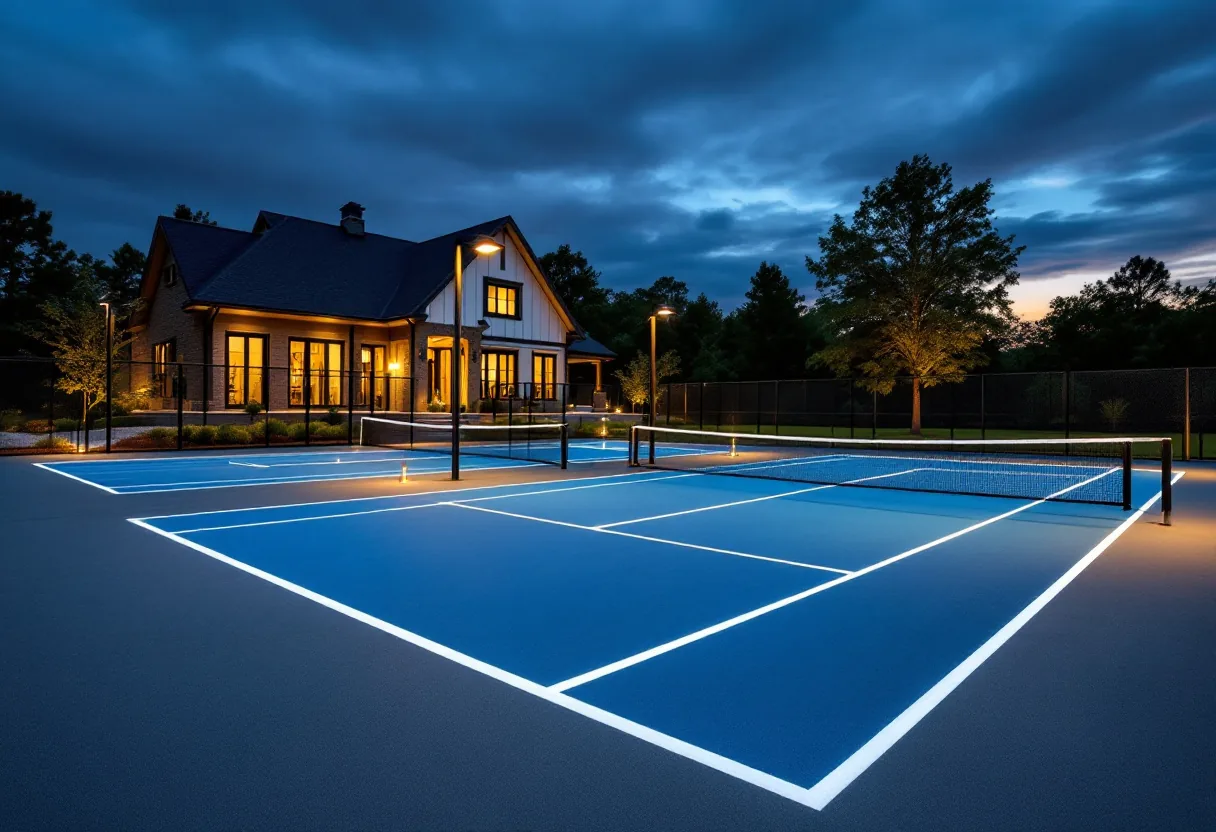
Pickleball is the amenity homeowner associations get asked for most, and boards keep hitting the same three questions: what it costs, who approves it, and what happens when the family closest to the site objects. None are hard problems, but they have to be worked in the right order. Boards that price a court and present it to the membership before settling on placement tend to spend their first meeting defending the location rather than the amenity. Resolve placement and noise first and the money conversation is usually the easy part.
Budget $20,000–$45,000 per court, confirm whether your governing documents let the board approve it from reserves or require a membership vote, and settle the location before the first community meeting. Placement is what decides whether the project is popular or contested.
What an HOA court costs
A community court is built to the same commercial standard as a club or park court, so it sits in the same range: roughly $20,000 to $45,000 per court, covering site prep, base, paving, an acrylic surface system, lines, and net posts set in concrete. Fencing and lighting move the number most, and both are close to mandatory on shared property — fencing keeps balls off lawns and cars, and lighting makes the amenity usable on weekday evenings, which is when most residents actually play.
| Scope | Typical planning range | Notes |
|---|---|---|
| Single community court | $20,000–$45,000 | Commercial-grade build; site conditions drive the spread |
| Per-court cost, multi-court build | Lower end of the range | Grading, mobilization and surfacing crews are already on site |
| Square-foot method | $11–$28 per sq ft | Useful for sanity-checking a bid against your actual footprint |
| Resurfacing, every 4–8 years | $1,500–$3,500 per court | The recurring cost that belongs in the reserve study |
If you are building more than one court, get the whole complex priced as a single project rather than as repeated single-court quotes. Our cost calculator will give you a defensible starting figure to bring to the board, and the full cost guide breaks down where the money goes.
Getting it approved
Start with the declaration and bylaws, not with a contractor. Most associations distinguish maintenance, which the board handles, from capital improvements, which often carry a dollar threshold, a reserve-spending rule, or a membership vote requirement. Anything funded by special assessment almost always requires a vote. Have association counsel confirm your reading before you commission a design; discovering the requirement late is what turns a popular amenity into a procedural fight.
Layered on top of the HOA process is the ordinary one: local zoning, setbacks from property lines, permits, and in some jurisdictions a lighting or hours-of-use restriction. Some municipalities treat a court as an accessory structure with its own setback rules. A builder who works in your area will know which apply, and it is worth asking before you present a site plan the town will not permit. Our guide to commercial and HOA court construction covers the build side of that process in more depth.
Noise is the deciding factor
The pop of a paddle is a sharp, repetitive, impulsive sound, and it carries in a way that steady background noise does not. On shared property that is a neighbor-relations problem before it is an acoustics problem, because the residents nearest the site have a vote at every meeting. Distance is the most powerful lever: choose the part of the common area farthest from bedrooms and patios, and orient the court so the direction of play faces away from the closest homes rather than toward them.
Where distance runs out, a solid acoustic barrier or sound-absorbing fence panels on the one or two sides facing homes do the rest. Posting quiet-paddle guidance and stocking approved balls is a cheap, good-faith gesture that carries weight with a skeptical resident. Posted hours cost the association nothing and remove the most common objection outright. Our guide to pickleball court noise solutions covers the full stack of mitigations and what each one actually achieves.
Sizing and site selection
The regulation play area is 20 by 44 feet, but a shared court needs run-out space for real play, and we recommend planning around a fenced pad of roughly 30 by 60 feet per court. Communities that build one court almost always wish they had built two, since open play with a rotation queues up fast. If the budget supports only one now, grade and plan the pad for the second so the addition is an expansion rather than a new project. See our dimensions guide for the full layout and spacing requirements.
The tennis court option
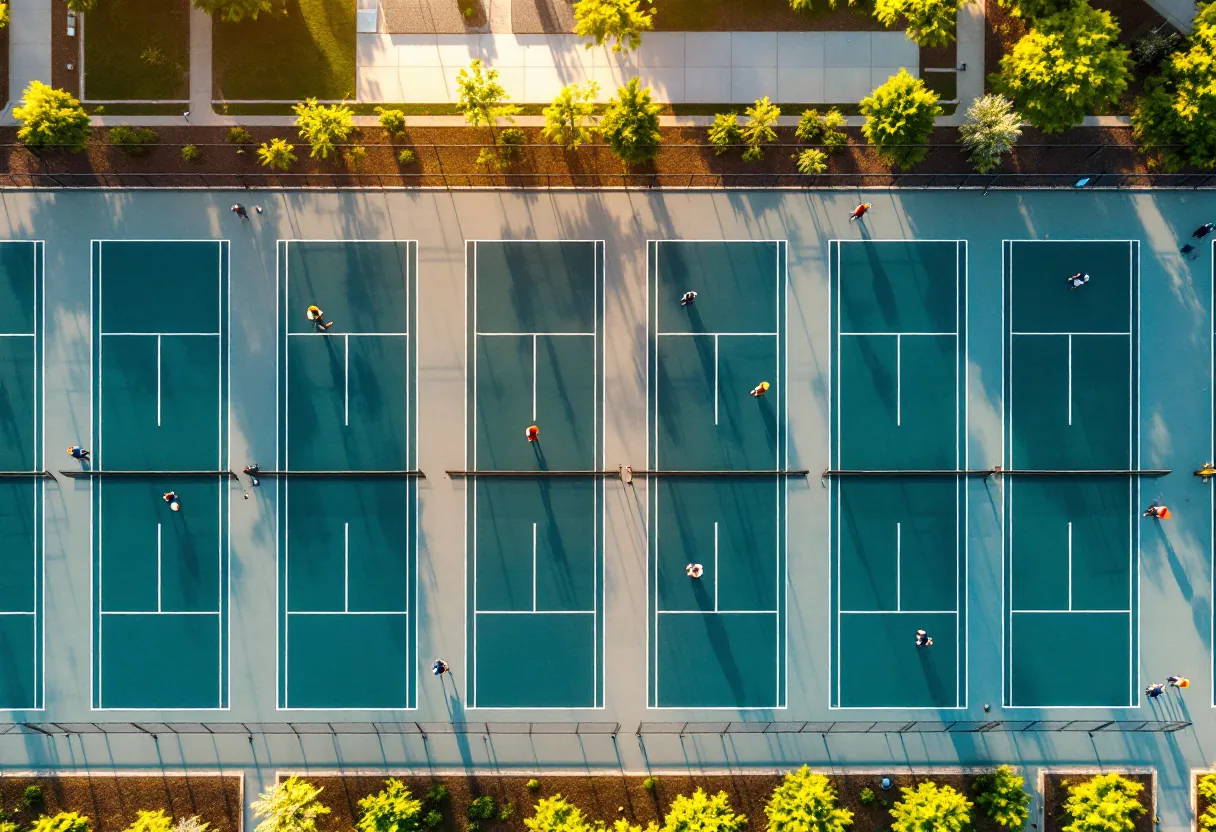
Many associations already own the cheapest pickleball courts available to them. A single tennis court footprint can hold up to four pickleball courts, or be striped for both sports so tennis players keep their court and pickleball players get theirs. Conversion cost depends almost entirely on the existing slab: sound pavement needs lines, nets and posts, while a cracked base or one that holds water needs repair first, and no amount of striping fixes a base problem. It is also an easier proposal than paving new common area, since it adds an amenity without taking green space from anyone. Our tennis court conversion guide walks through both the shared-striping and full-conversion approaches.
Put it in the reserve study. A court is a long-lived asset with one predictable recurring expense. Adding a $1,500–$3,500 per-court resurface on a 4 to 8 year cycle to the reserve schedule — at the short end of that range, since shared courts see heavier play — keeps a future board from facing a surprise assessment.
Frequently asked
Sometimes. Many governing documents let the board fund a capital improvement from reserves below a stated dollar threshold, and require a membership vote above it or for anything funded by special assessment. The answer is in your declaration and bylaws, and it is worth confirming with association counsel before spending on design.
Two is the number most communities end up wanting. Open play with a rotation backs up quickly on a single court. If the budget supports only one, grade and plan the site for a second so adding it later is an expansion rather than a fresh project.
Address it before the vote rather than after. Move the court to the farthest usable point on the common area, orient play away from the nearest homes, add acoustic panels on the facing sides, and adopt posted hours. Bringing those decisions to the meeting already made turns the objection into a discussion about details.