The most common surprise on a court project is not the price, it is the calendar. A new court is a sequence of dependent stages, and the longest one, concrete cure, happens with nobody on site at all. This guide lays out each stage, its realistic duration, and the decisions that decide whether you play in six weeks or in four months. When you are ready to lock in a start date, our free quote service matches you with vetted builders who can tell you their actual lead time this season.
New backyard court on a fresh slab: 6 to 10 weeks from permit approval to first serve. Resurfacing or converting an existing slab: 1 to 2 weeks for acrylic, a few days for modular tile. Commercial multi-court facilities: 3 to 6 months once site plan approval is in hand. Permit review sits in front of all of these and is the least predictable piece.
The stage-by-stage timeline for a new court
The durations below assume a single 30×60 ft pad around the 20×44 ft playing area, poured in concrete, with a post-tensioned or reinforced slab, an acrylic surface, fencing, and no major grading problems. Every stage waits on the one before it, so the numbers add rather than overlap.
| Stage | Typical duration | What is happening |
|---|---|---|
| Permits and approvals | 1 day to 8+ weeks | Building, zoning, fence, and electrical review; HOA sign-off if applicable |
| Layout, excavation, base | 3 to 7 days | Staking the pad, stripping topsoil, compacting the stone base, setting drainage |
| Forming and pour | 1 to 3 days | Forms, reinforcement or tension cables, the pour itself, finishing |
| Concrete cure | About 28 days | Slab gains strength and releases moisture; no coatings can go on yet |
| Surfacing and lines | 5 to 10 days | Crack fill, resurfacer, color coats, line paint, each with dry time between |
| Fence, net, lighting | 2 to 5 days | Posts and fabric, net system, fixtures and trenching if lit |
Add the working stages together and you get roughly two to four weeks of actual crew time wrapped around a four-week cure. That is why builders quote six to ten weeks for the whole job and why a smaller court does not finish meaningfully faster than a larger one. The step-by-step build guide walks through what happens inside each stage.
Why concrete cure controls the schedule
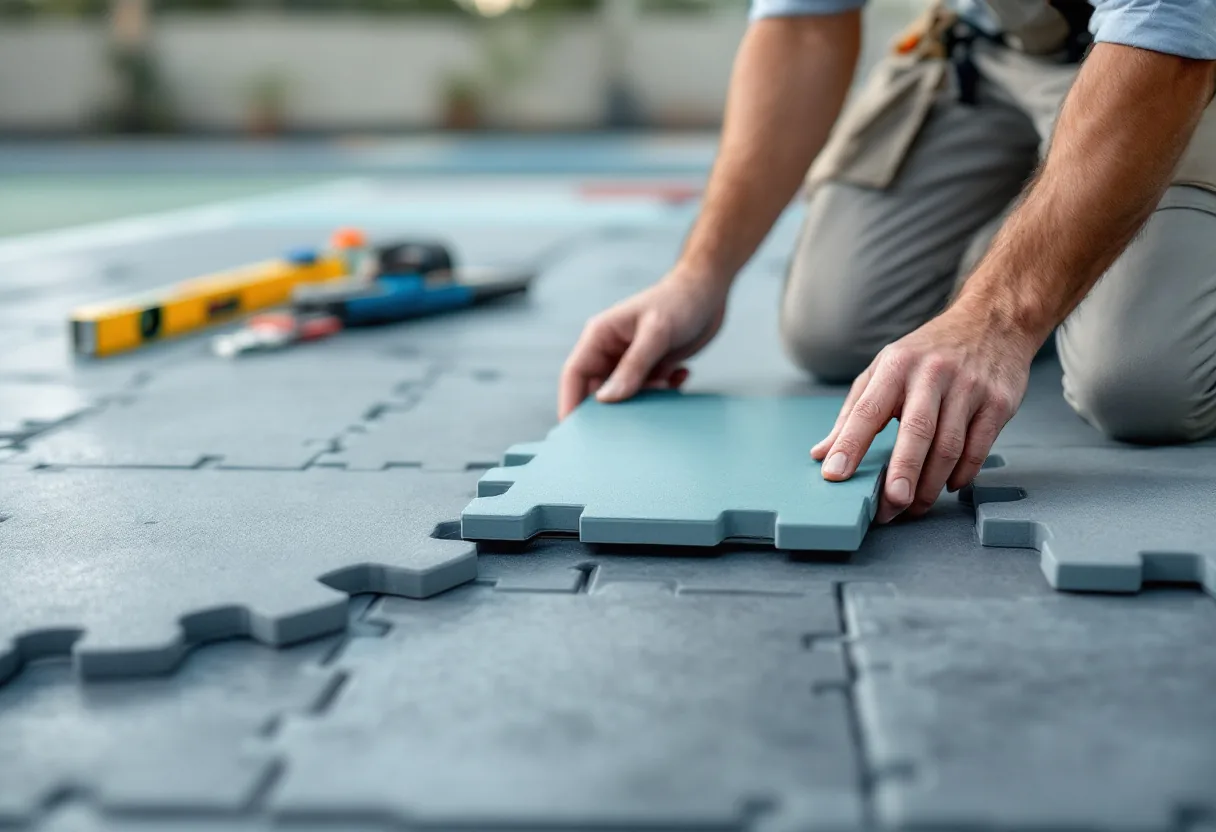
Concrete reaches most of its design strength at about 28 days, and acrylic coating manufacturers require a cured, dry slab before the first coat. Coating too early traps moisture under the surface, which shows up later as bubbling and peeling that no warranty will cover. A reputable builder will not shorten this window, and you should be wary of one who offers to. If speed matters more than the classic acrylic finish, a modular tile surface can go down as soon as the slab is walkable and checked for flatness, which trims the calendar by weeks. Our surfaces guide compares the options.
Asphalt is quick to pave but must release its oils before coating, and in cooler climates that wait can outlast a concrete cure. The concrete vs. asphalt comparison covers the tradeoff.
What stretches the timeline
Permits. A simple residential slab can be approved over the counter. Anything involving a tall fence, lighting, stormwater review, or an HOA architectural committee can add weeks before a shovel moves. Read the permit guide and start applications before you sign a construction date.
Weather. Concrete cannot be poured in freezing conditions or heavy rain, and acrylic coats need warm, dry days with low overnight humidity. In most of the country that makes late spring through early fall the productive window, and it is also when builders are busiest, so lead times to get on the schedule grow.
Site conditions. A sloped yard, poor soil, tree roots, or a high water table means more excavation, retaining walls, or engineered drainage, each of which adds days and sometimes a separate contractor.
Decisions made late. Fence height, lighting, court colors, and net system all affect what gets set in the slab or trenched under it. Changing your mind after the pour means rework. Settle these during the quote stage.
Builder backlog. The best court contractors book weeks or months out in peak season. The timeline above starts when the crew arrives, not when you sign.
Faster paths: conversions and resurfacing
If you already have a tennis court, driveway slab, or old sport court, you skip the longest stage entirely. A tennis court conversion that keeps the existing slab is typically one to two weeks for crack repair, resurfacing, and new lines, and one tennis court yields up to four pickleball courts. A resurfacing job on a sound pad runs on a similar clock. Portable nets and temporary lines can have you playing the same day while you plan the permanent work.
How to shorten a new build
Get permits and HOA approval in hand before you hire, so the builder's start date is real. Choose a builder who self-performs the concrete, which removes a scheduling handoff. Pour early in the season so the cure lands in warm weather. Finalize surface, color, fence, and lighting choices before the pour. And ask every bidder for their current lead time in writing, because a lower price from a builder who cannot start for four months is not a faster court. Our cost guide covers what to expect in the $20,000 to $50,000 backyard range so you can compare bids on both price and schedule.
Frequently asked
Not on a new concrete pad. A resurfacing or tile install on an existing slab can finish inside a week, and portable nets on a driveway take an afternoon, but a new slab needs its cure time before the surface goes on.
Aim to pour in late spring or early summer so the cure and the coating both land in warm, dry weather, and get on your builder's schedule in winter, before peak-season backlogs form.
Plan on three to six months after site plan approval for a multi-court facility, since grading, stormwater, parking, lighting, and accessibility work all scale with the site. Builders quoting commercial courts at $20,000 to $45,000 per court should give you a phased schedule alongside the price. Get matched with them through our free quote service.