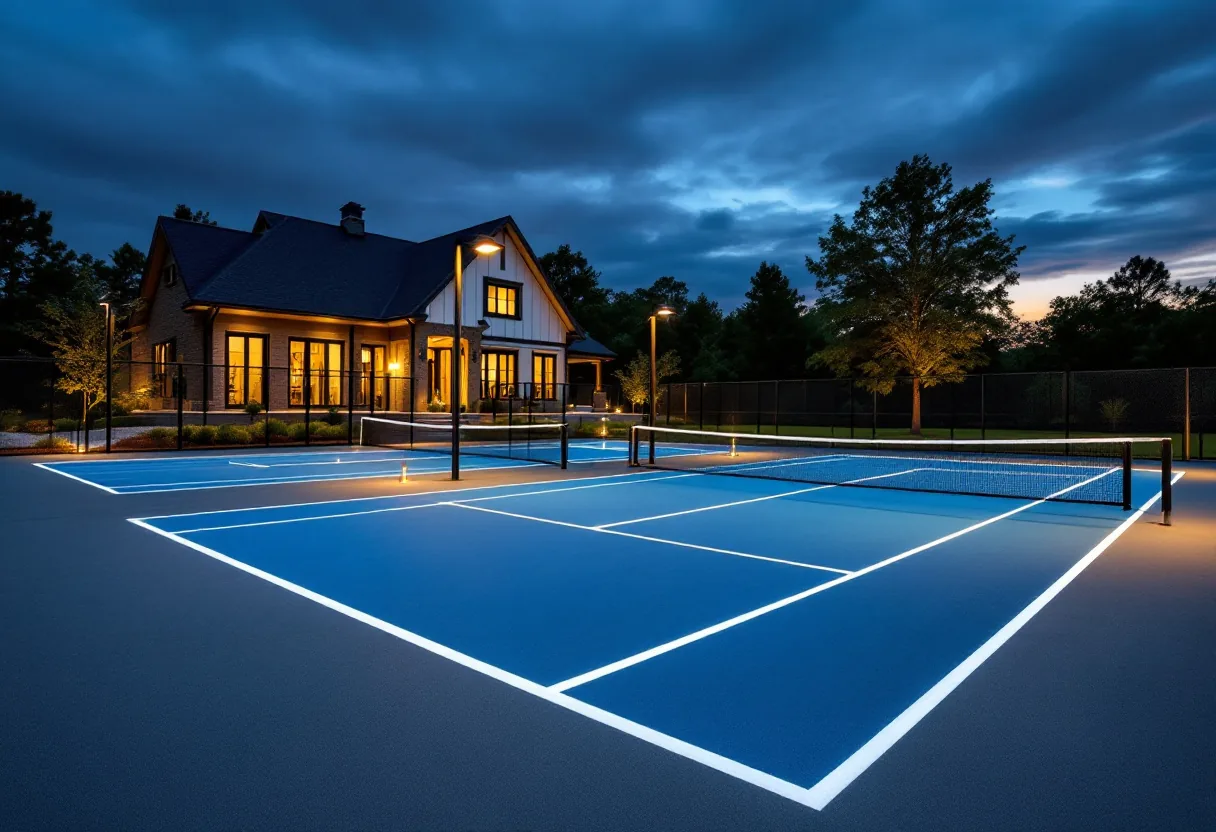
Almost every expensive court failure — cracked slabs, peeling acrylic, frost heave, permanent birdbaths — traces back to water. Either it sat on the surface, or it got underneath the slab. Drainage is decided before the first yard of concrete is poured, which is why it belongs at the top of your planning list alongside the overall budget. Here is how builders handle it, and what to check before you sign a contract.
Slope the court about 1% in one continuous plane (never crowned), grade the surrounding ground away from the slab, and intercept uphill runoff with a swale or French drain. Typical drainage budget: $1,000–$4,000 on top of site prep.
The 1% slope rule
A hard court sheds water by falling evenly in one direction — one flat, tilted plane from edge to edge. That pitch is steep enough to drain but shallow enough that players never notice it. On a recommended 30×60 ft pad, the math looks like this:
| Slope direction | Distance | Total fall at 1% |
|---|---|---|
| Side to side (preferred) | 30 ft | ~3.6 in |
| End to end | 60 ft | ~7.2 in |
| Corner to corner (diagonal) | ~67 ft | ~8 in |
Side-to-side is usually preferred because water leaves the play area (the 20×44 ft lined court) faster and the fall stays small. Two things a good builder will never do: crown the court like a road, which splits drainage in two directions and complicates play, or pitch it toward a wall, slope, or structure that traps the runoff at the fence line.
Where the water goes: the systems builders use
The slope gets water off the court. The rest of the drainage plan decides what happens next — and this is where sites differ:
| System | What it does | Best for |
|---|---|---|
| Perimeter grading | Ground slopes away from the slab on all sides | Every court, no exceptions |
| Swale (shallow graded channel) | Steers surface runoff around the court | Yards with mild uphill grade |
| French drain | Gravel-and-pipe trench that intercepts subsurface water | Sloped lots, wet soils |
| Channel drain / catch basin | Collects sheet flow at the low edge and pipes it away | Courts near patios or structures |
| Dry well | Underground pit that stores and soaks away collected water | Sites with no downhill outlet |
On an easy, gently sloped lot, perimeter grading plus a swale may be all you need. On a cut-into-a-hillside build, expect a French drain on the uphill side as standard practice — intercepting water before it reaches the base layers is far cheaper than repairing a heaved slab later.
What drainage costs
In our 2026 cost guide, drainage shows up as a $1,000–$4,000 line item on a typical backyard build, inside a broader site prep and grading budget of $2,000–$10,000+. Flat, well-drained lots land at the bottom of that range. Heavy clay soil, a high water table, or a court cut into a slope push toward the top — and occasionally beyond it. That is money well spent: the slab and base are roughly two-thirds of your court's total cost, and drainage is what protects them.
Drainage and your surface choice
Surface systems handle water differently. Acrylic-coated concrete sheds everything across the top, so slope is doing all the work. Modular tile systems drain through the tiles to the pad below, which makes them more forgiving of light rain but still dependent on a properly sloped pad underneath. And the base material matters too: our concrete vs asphalt comparison covers how each base handles moisture and freeze-thaw cycles over time.
Warning signs on an existing court
Evaluating a court you already own, or a property you are buying? Look for standing water more than an hour after rain, birdbaths (shallow puddled depressions) in the play area, moss or dark staining along one edge, cracks that follow a low spot, and coating that peels or bubbles in patches. Those are drainage symptoms, not just surface wear — fix the water problem first, then plan resurfacing, or the new coating will fail the same way the old one did.
Frequently asked
No — a dead-flat court holds water in every minor imperfection of the slab. Roughly 1% of fall in one plane is the standard because it drains reliably while remaining unnoticeable during play.
Often, yes. Many municipalities regulate where you can discharge stormwater, and HOAs may have their own rules. Your builder should handle this as part of the site plan — ask how runoff will be routed and where it discharges before work begins.
Many surfacing contractors exclude failures caused by standing water or moisture coming up through the slab. If a court ponds, resolve the grading or drainage issue before paying for a new surface.