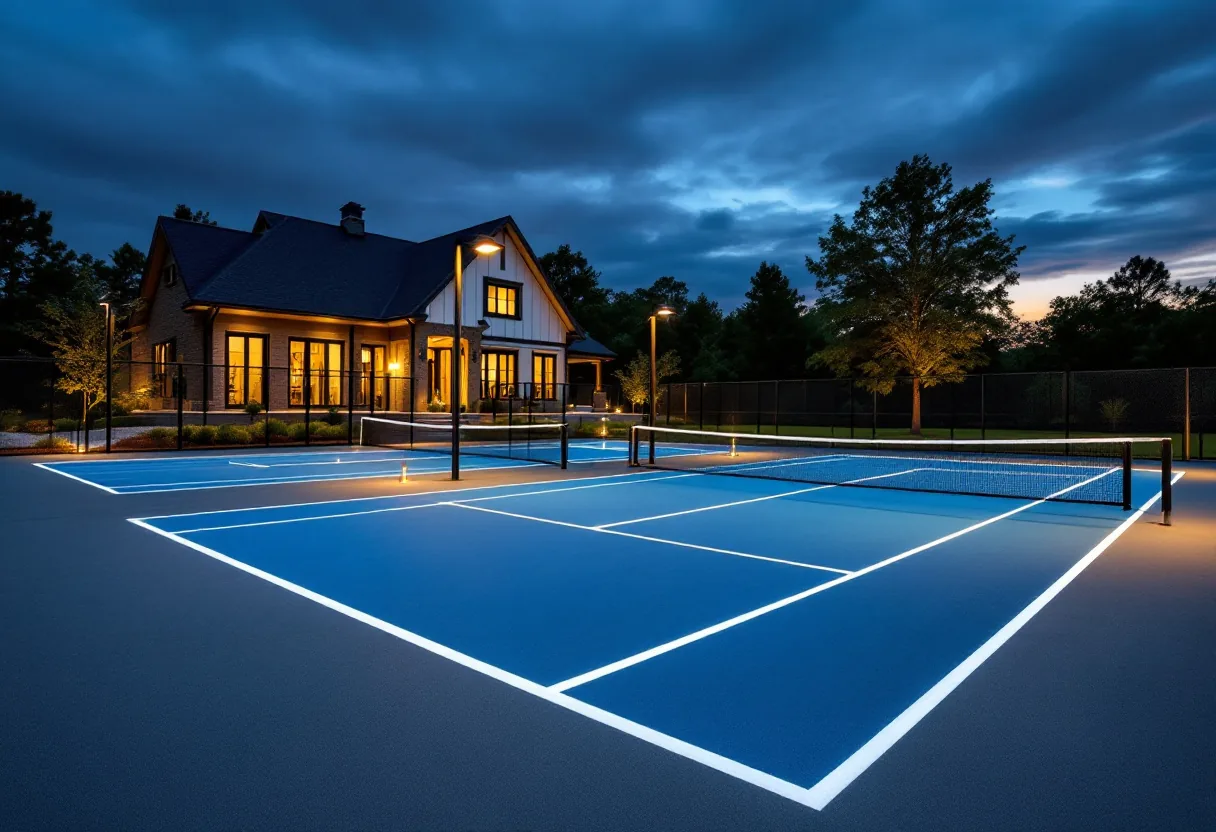
Almost every homeowner pricing a pickleball court eventually asks whether the kids can shoot hoops on it too. The answer is yes, and it is usually the smartest money on the project. But combo courts go wrong in two predictable ways — the pad gets sized for pickleball alone and basketball ends up cramped, or the lines get painted without a plan and both games become harder to read. Both are avoidable at the drawing stage. Neither is fixable after the concrete cures.
A 30×60 ft pad fits a full pickleball court plus a hoop at one end — great for shooting and 2-on-2. A regulation basketball half court is 50 ft wide, so a true combo court wants roughly 50×70 ft. Budget from $20,000 to $56,000 depending on which size you choose.
Start with the footprints, not the budget
Every sport you want has a fixed play area. Line them up and the right pad size becomes obvious:
| Sport | Play area | Notes |
|---|---|---|
| Pickleball | 20 × 44 ft | 30×60 ft pad recommended for run-off |
| Badminton (doubles) | 20 × 44 ft | Identical footprint — free second sport |
| Volleyball | ~30 × 60 ft | Matches the recommended pickleball pad |
| Basketball half court (regulation) | 50 ft wide | 47 ft deep from baseline at pro/college depth |
| Basketball half court (high school) | 50 × 42 ft | Half of an 84×50 ft full court |
Two useful surprises live in that table. A doubles badminton court is exactly the same 20×44 ft as a pickleball court, so you get it for the price of one extra set of posts, and a volleyball court fits the standard 30×60 ft pad as-is. Basketball is the sport that forces a bigger pour, because 50 ft of width is 20 ft more than the pickleball pad gives you.
The four pad sizes that make sense
Costs below use the same $11–$16 per square foot range as a standard acrylic hard court over concrete, from our 2026 cost guide. Cushioned acrylic, modular tile, and post-tension concrete run higher — up to about $28 per square foot at the top end.
| Pad size | Sq ft | What it gives you | Est. cost |
|---|---|---|---|
| 30 × 60 ft | 1,800 | Pickleball + hoop at one end; narrow for basketball | $20,000–$29,000 |
| 36 × 60 ft | 2,160 | Same, with real sideline room for driving the lane | $24,000–$35,000 |
| 44 × 64 ft | 2,816 | Near-regulation half court depth, still under 50 ft wide | $31,000–$45,000 |
| 50 × 70 ft | 3,500 | Full-width half court + full pickleball court | $39,000–$56,000 |
The best value on this page is the jump from 30×60 to 36×60. It costs a few thousand more in slab and surface, and it is the difference between a hoop you shoot at and a court you can play on. Going all the way to 50×70 pays off only if real basketball games are part of how the court will be used.
Lining a combo court so both games stay readable
Overlapping lines are the most common complaint about combo courts, and the fix is contrast discipline rather than fewer lines:
- Pick a primary sport. Whichever gets played most gets the highest-contrast lines — usually crisp white against a darker playing surface.
- Mute everything else. Secondary sports get a tone only a step or two off the surface color. Visible when you look for it, invisible when you are not.
- Keep pickleball lines 2 inches wide. That is the standard width, and it is what your eye expects when a ball lands near a line.
- Protect the non-volley zone. Never route a basketball key or arc line through the kitchen. That is where the fastest in-or-out judgments happen.
- Sleeve the posts, do not surface-mount them. In-ground sleeves with flush caps let you swap between a pickleball net, badminton posts, and volleyball standards without leaving hardware to trip over.
Our court colors guide covers which surface and line combinations hold up visually, and the dimensions page has the full pickleball layout with every measurement.
The extras a combo court adds
Three line items separate a combo court from a single-sport build. The hoop system is the big one, and it is worth deciding early: an in-ground adjustable-height goal needs its footing poured during construction, while a portable base can be added any time but eats court space and moves when you lean on it. Ask for the hoop as an itemized line on your quote.
The other two scale with the pad. Fencing runs $2,000–$6,000 on a standard court, and a wider pad means more linear feet — see the fencing guide for heights and types. Basketball also sends balls higher and farther than pickleball does, so most combo builds put taller fence behind the hoop end. Lighting runs $5,000–$10,000+ for two to four poles, and a wider court may need a fourth pole where a pickleball-only court needed two.
Converting instead of building
If you already have a slab or an old sport court, the math changes completely. Resurfacing and lining a sound existing surface typically runs $1,500–$3,500, a fraction of a new pour. A tennis court is the best conversion candidate of all — it holds up to four pickleball courts, or a mix of pickleball and a full basketball half court with room to spare. Have the slab evaluated for cracks and drainage first, because a new coating over a failing base fails the same way the old one did.
Frequently asked
Yes, with a portable goal or a wall-mounted system. An in-ground goal is harder after the fact because it needs a footing dug adjacent to the finished slab, which risks the edge of the pad. If basketball is even a maybe, tell your builder before the pour and have them set a sleeve.
Not materially. Budget the same roughly $300–$1,000 per year for cleaning and upkeep. The one difference is line wear: basketball creates concentrated scuffing under the hoop and along the key, so that area may show first at resurfacing time.
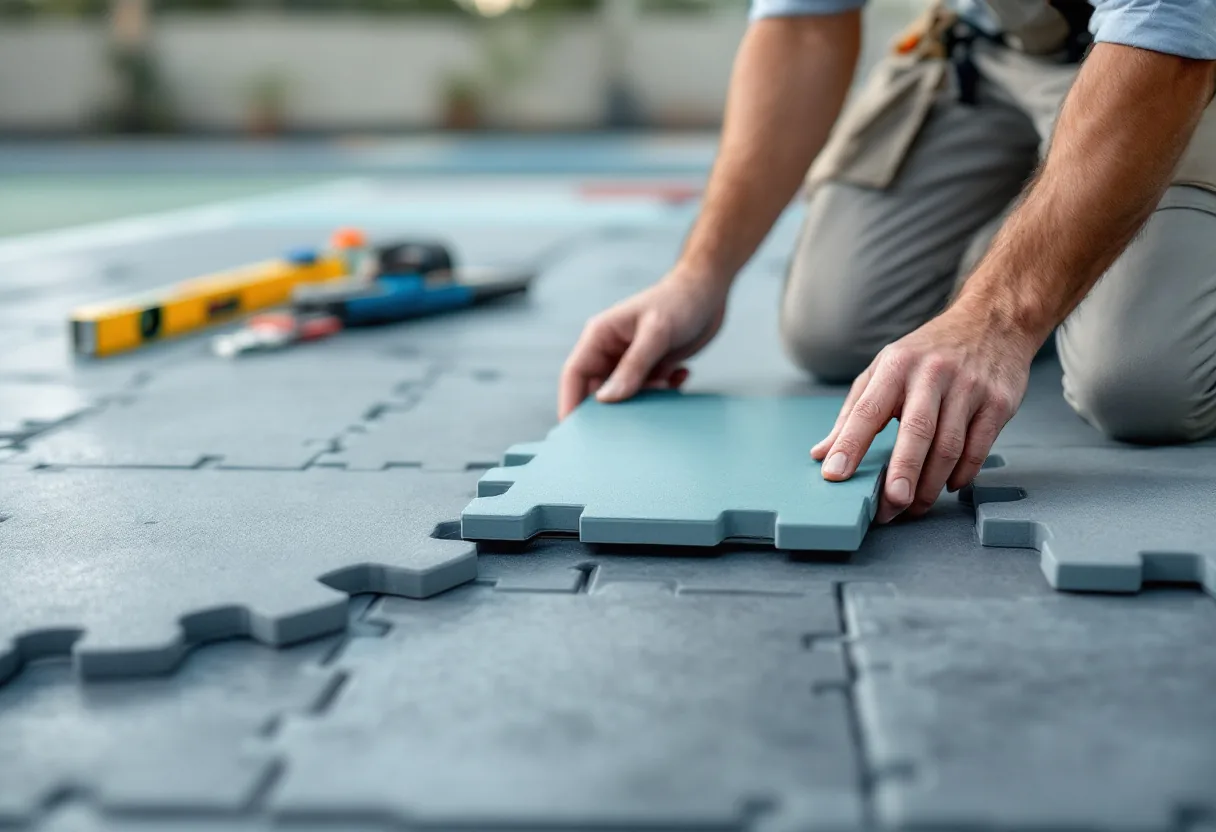
Acrylic over concrete is the most common and the most economical. Modular tile is the other strong option, because tile color can define separate playing zones without painting extra lines, and it drains through to the pad. Cushioned acrylic is easier on knees, which matters more once basketball is in the mix. Compare all four on the surfaces guide.