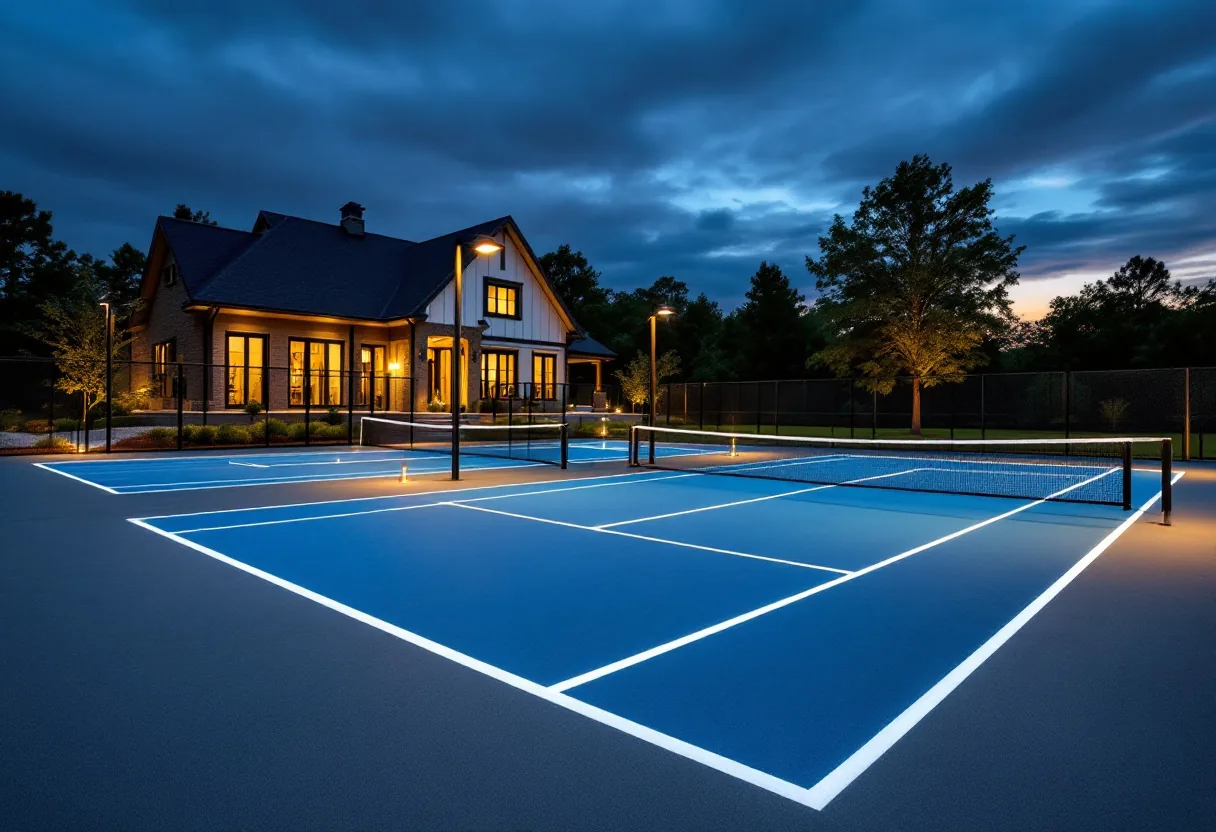
Homeowners usually focus on surface color and lighting, but the work you never see — clearing, grading, drainage and base preparation — is what protects your investment. Concrete makes up roughly two-thirds of a court's cost, and a slab is only as good as what is underneath it. This guide walks through what site prep involves so you can compare builder quotes with confidence. When you are ready for real numbers, the cost calculator gives you an instant range.
Plan on a 30×60 ft pad (1,800 sq ft) for a 20×44 ft playing area. Site prep and grading typically add $2,000–$10,000+, and drainage work adds roughly $1,000–$4,000. The finished court needs a slope of about 1% so water runs off.
Step 1: Choose and measure the site
The playing area of a pickleball court is 20×44 feet, but you should never prepare only that footprint. The recommended pad is 30×60 feet, which leaves room for run-off behind the baselines and sidelines, net posts, and fencing. Check the full dimensions on our court dimensions guide before you mark the area.
Look for the flattest, best-draining spot with good access for equipment. A site close to trees, a septic field, utility lines or a property line adds cost or complications, so flag these to builders up front.
Step 2: Clearing and excavation
Grass, topsoil, roots, stumps and debris must come out, because organic material decays and settles unevenly under a slab. Depending on the yard, this can mean removing trees, hauling away soil, or demolishing an old patio or shed. Tight backyard access can limit what machinery fits, which pushes labor costs up.
Step 3: Grading and slope
A pickleball court is built with a gentle slope, about 1%, so rain drains off the surface instead of pooling. On a flat lot this means shaping the subgrade carefully; on a sloped lot it may require cut-and-fill grading or a retaining wall. Sloped and uneven yards are the most common reason site prep lands at the high end of the range. Our drainage and slope guide covers how water should leave the court and where it should go.
Step 4: Compacted base
Once the soil is graded, builders typically compact the subgrade and add a compacted aggregate base. This layer provides stable, even support. Soft or clay-heavy soil may call for extra base material or soil stabilization, so ask each builder how they handle your soil conditions.
What changes the site prep price
| Factor | Typical effect |
|---|---|
| Site prep & grading (clearing, leveling) | $2,000–$10,000+ |
| Drainage (court must slope ~1%) | $1,000–$4,000 |
| Trees, stumps and heavy clearing | Higher end of range |
| Sloped yard needing cut-and-fill or a wall | Higher end of range |
| Poor access for equipment | More labor time |
| Soft or wet soil | Extra base or stabilization |
These add-ons sit on top of the surface system itself, which runs about $11–$28 per square foot installed. See the full breakdown in the pickleball court cost guide.
Before you request quotes
You can help builders give accurate numbers by gathering a few details first: where the court will go, how level the area is, what currently sits there, where water flows during heavy rain, and how equipment can reach the spot. Photos of the yard help. Also confirm whether you need approval before breaking ground, since grading can trigger local rules; read our guide on pickleball court permits. And allow time: a typical backyard court takes about 2–4 weeks once site prep begins, depending on weather and concrete cure time.
Frequently asked
Site preparation and grading typically add about $2,000–$10,000+ depending on clearing, slope, soil and access. Drainage work adds roughly $1,000–$4,000 more.
The playing area is 20×44 feet, but the recommended pad is 30×60 feet (1,800 sq ft) to allow room for run-off, fencing and net posts.
Often yes. The finished court needs a slope of about 1%, so a sloped yard usually needs cut-and-fill grading or a retaining wall, which raises the site prep cost.