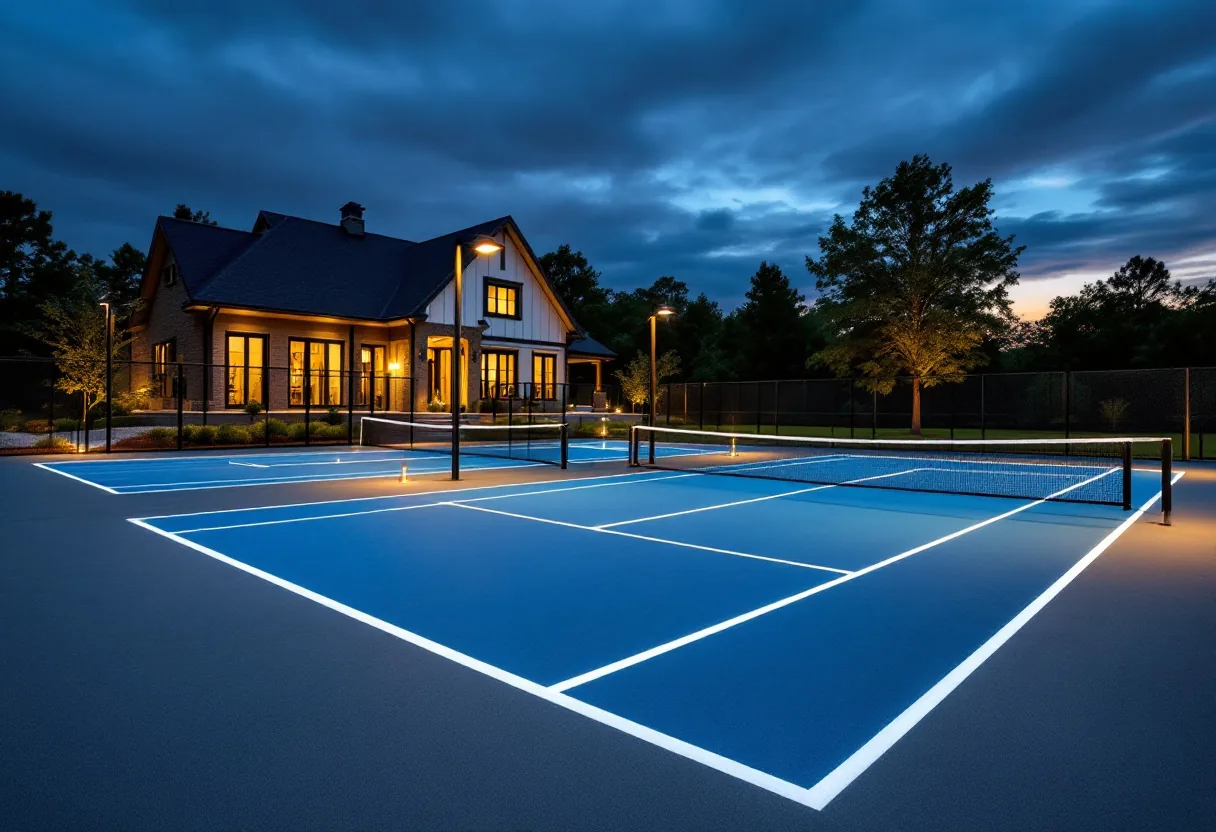
Pickleball courts look simple: a flat rectangle, some paint, a net. That is exactly why so many homeowners wonder if they can save money by building one themselves. The honest answer depends on which part of the job you mean. Some steps are very DIY-friendly. Others are unforgiving, and mistakes there are expensive to undo. Use this guide to decide where to spend your own time and where a professional pays for itself, then use the cost calculator to see a realistic range for your site.
Backyard court: $20,000–$50,000 ($11–$28/sq ft). Concrete is roughly two-thirds of the cost. Resurfacing an existing slab: $1,500–$3,500. The base is the step to hand to a professional.
Where the money actually goes
Before comparing labor costs, it helps to know what you are paying for. In a typical court, the foundation (clearing, grading, drainage and the concrete slab) makes up the bulk of the budget. The colored surface on top is the smaller line item. That matters for DIY thinking: the part with the biggest price tag is also the part that is hardest to redo if it is wrong. Our site prep guide walks through what that first phase involves.
DIY vs contractor at a glance
| Phase | DIY realistic? | Why it matters |
|---|---|---|
| Clearing & grading | Rarely | The court needs a consistent slope of about 1% to shed water |
| Drainage | Rarely | Ponding ruins surfaces and play; see drainage & slope |
| Concrete slab | No, for most owners | A poorly poured or cured slab cracks and takes the surface with it |
| Surface coating | Sometimes | Doable on a sound slab if you follow cure and weather limits |
| Lines & net | Yes | Straightforward with the right dimensions |
| Lighting & fencing | Mixed | Electrical work and post footings are usually best left to licensed trades |
Where DIY makes sense
The strongest DIY case is a project that skips the foundation entirely. If you already have a sound concrete slab, driveway or old sport court, resurfacing and lining typically runs $1,500–$3,500, and a portable net gets you playing. You can also take on finishing tasks such as cleaning, painting lines to spec, installing a net system ($300–$1,500) and adding windscreens ($80–$500+). Converting space you already own is another value play, since one tennis court fits up to four pickleball courts.
Whatever you do yourself, build to the official size. The playing area is 20 x 44 ft, and a 30 x 60 ft pad (1,800 sq ft) leaves comfortable room around it.
Where a contractor earns the fee
A new slab is the clearest example. Concrete work is permanent: if the grade is off, the court holds water, and if the slab cracks, the surface above it will too. An experienced crew brings equipment, a tested base design and a finishing process that is hard to replicate on a first attempt. Professionals also handle the paperwork side. Many areas require approvals, so check our guide to court permits before breaking ground, and see how to choose a builder if you decide to hire.
The hybrid approach
For many owners the smartest plan splits the job. Hire a professional for grading, drainage and the slab, then handle selected finishing items yourself, such as the net, windscreens or ongoing cleaning. Ask each bidder to price the project in separate line items so you can see exactly what you would save by taking a piece in-house. Budget about $300–$1,000 per year afterward for cleaning and minor upkeep.
A simple decision rule
If your project starts from bare ground, get professional quotes for the base. If it starts from a sound existing slab, DIY resurfacing is realistic and can keep costs near the low end. In both cases, getting two or three itemized quotes costs you nothing and gives you a benchmark to measure any DIY plan against.
Frequently asked
Yes, but the foundation is the hard part. Grading, drainage and a properly cured concrete slab are where most DIY courts fail. Many owners do the easy finishing work themselves and hire a professional for the base.
Labor is the main saving, but concrete makes up roughly two-thirds of a typical court's cost, and a mistake in the base can erase any savings. Itemized quotes show you the real difference.
Resurfacing and lining a sound existing slab or driveway, often $1,500–$3,500, plus a portable net.